Friday, April 22, 2005
Broadcasting & Cable: The Business of Television
If the court agrees with Grokster, P2P could become a distribution mechanism to rival other broadband entrants, like Verizon's VCast wireless mobile network or online media portals like Yahoo, says Weiser.
Either way, he says, marketers need to start planning for the 'contextual' advertising--think product placement and integrated marketing--and direct response models, to reach the younger audience that will migrate to new tech TV.
As an example of how not making video content available online for fear of pirating is a losing strategy in the face of a growing desire for online access to TV, Weiser points to a report from UK P2P tracker Envisional that downloads of the UK's most-downloaded U.S. show, Fox's 24, went from an average of 35,000 for per episode in 2003-2004 to 95,000 for this season."


FW: Bloglines - Online anonymity
From: Bracken, John
Sent: Friday, April 01, 2005 4:05 PM
To: IPblog (E-mail)
Subject: FW: Bloglines - Online anonymity
| |||||
|
FW: WSJ.com - Students Toss Textbooks Aside And Download Articles Online
From: Bracken, John
Sent: Thursday, April 21, 2005 11:47 AM
To: Bracken, John
Subject: WSJ.com - Students Toss Textbooks Aside And Download Articles Online

| ||||||||||||||||||||||||||||||||||||||||||||||||||||||


Friday, April 15, 2005
Hollywood Looks to BitTorrent for Distribution
Tuesday, April 12, 2005
The countdown for the extinction of CDs is about to begin - Blog Maverick - www.blogmaverick.com _
newspaper v. google ad revenue for 2004
$1.19 billion, with nearly half that amount coming from classifieds.
Revenue for google adwords, year 2004:
$3.143 billion;roughly half that amount on google, the other half on third-party websites (the adsense program)."
WikiNews beats MSM
"Imagine an encyclopedia," wrote blogger Joe Gratz, "that had someone’s death noted in their biography before the first major news outlet had even published an obituary." The death was that of feminist writer and campaigner Andrea Dworkin, the encyclopedia Wikipedia, and Gratz was imagining nothing.
Guardian Unlimited reported Dworkin's death, confirmed by her agent, shortly before 1800 GMT yesterday, the first major news outlet to do so, though the correct date of her death was posted at the top of her Wikipedia biography at least 24 hours earlier.
Wikipedia's discussion page explains how it happened. The news was circulating on feminist mailing lists shortly after Dworkin died in her sleep on Saturday, and from there it found its way to the encyclopedia and some blogs. But a lack of corroboration from the press and certainty over the source - again gone over on the discussion page - meant the Wikipedia writers and some of their readers could not decide if it was true. The correct date was taken down at least once, and the item hardly pushed.
Studios Go After Students Who Use 'i2hub'
Thursday, April 07, 2005
RIAA fear corruption of Internet2 by file-swappers
Monday, April 04, 2005
Boing Boing: Valenti signs Betamax tape for fan at Grokster hearing
Smart Mobs: Clay Shirky blocked from posting his own talk by DVD DRM
Friday, April 01, 2005
FW: Bloglines - Ten million CC licenses in a pie chart
From: Bracken, John
Sent: Friday, March 04, 2005 9:52 AM
To: Bracken, John
Subject: Bloglines - Ten million CC licenses in a pie chart
| |||||
|
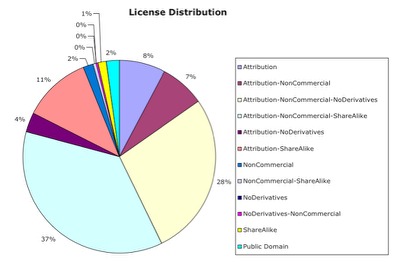 Creative Commons has published a fascinating pie-chart showing the frequency with which each CC license appears appears in the wild, drawing on 10,000,000 CC licenses that are discoverable with Yahoo.
 FW: Fair Use at Hammer Museum
http://www.hammer.ucla.edu/exhibitions/84/
March 1 - May 29, 2005
Fair Use features works by Candice Breitz, Omer Fast, Christian Jankowski, Les LeVeque, Matthias Müller, and Eddo Stern on video monitors in the Hammer Museum's lobby gallery. Presenting varied strategies of appropriation and sampling in film and video from the last decade, Fair Use explores the exceedingly prevalent redirection and alteration of existing media. These processes resonate in work by artists who treat media as raw material and who turn the tools and products of information distribution against itself.
